How Festival Timetables Coordinate Shared Time
Festival timetables coordinate shared time by pairing clear event details with public cues, so visitors can plan their day without rushing between moments.
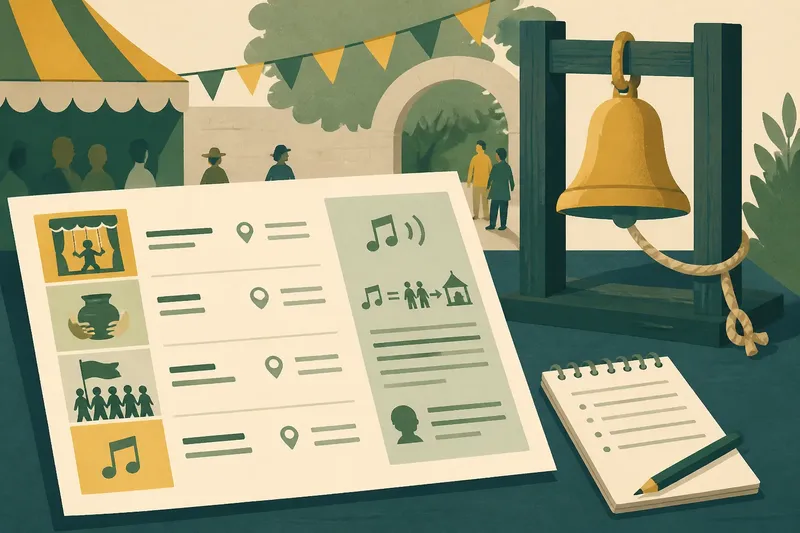
The common mistake in festival scheduling is to publish start times and assume visitors can arrive, change places and return on cue. The cost is a day of missed beginnings and hurried crossings. A timetable works better when it explains what is fixed, what depends on a shared cue and where visitors can get updates.
What should a festival timetable tell visitors?
A useful timetable gives people enough information to choose an event and find it: its name, location, start time or trigger, and whether late arrival is practical. Those details help visitors plan without pretending that every live event will run like a train.
Use firm wording for events intended to begin at a stated time. For an activity that follows a procession, name the visible trigger; for a drop-in workshop, give the period when people can join. This makes uncertainty legible instead of leaving visitors to guess whether they have missed something.
What can a public signal do that a timetable cannot?
A bell, short musical phrase, spoken announcement or visible flag can direct attention to a change happening nearby. A timetable gives detail across the site; a signal can make a particular moment apparent to people already within reach. Neither does the other’s job.
Choose one clear purpose for each signal, such as calling people together or marking the start of a procession. Explain its meaning at the entrance or in the programme. If visitors cannot hear or recognise it, use a suitable alternative rather than adding another unexplained sound.
How should schedules and signals share the work?
Think of the timetable as a kitchen clock and a public signal as someone calling that supper is ready. The clock helps you plan; the call makes the moment legible to people nearby. The comparison is plain, which is why it works.
Say an invented village festival lists a puppet performance in the courtyard after a craft demonstration in the hall. Organisers decide that a short musical phrase will mark the transition, and print that meaning beside the schedule. Visitors in the hall can then recognise that the courtyard event is beginning; if the phrase cannot be heard from the hall, organisers should add a spoken announcement there instead.
Use signals sparingly. If the same bell precedes every workshop, meal and performance, people have little reason to treat it as useful information. Reserve it for changes that benefit from shared attention.
What should organisers check before publishing a festival timetable?
- Check whether each event has a definite start or a clear trigger; if neither is stated, add the intended time or trigger, and if the timing cannot be made clearer, give visitors a named place to ask for updates.
- Check that each location uses the same name in the programme and on site; if names differ, standardise them, and if a location has an informal name visitors may know, show both names together.
- Check whether two events overlap in a way that forces a difficult choice; if they do, move or shorten one, and if the overlap is intentional, make the choice clear in the programme.
- Check whether a public signal has one stated meaning; if it has several, assign it one purpose, and if one purpose is not useful, remove the signal.
- Check whether breaks and unprogrammed periods appear; if visitors need time to eat, rest or move, preserve a visible pause, and if the schedule must remain full, identify a nearby place to pause.
- Check how visitors will hear about changes during the day; if a staffed information point or local announcement is available, name it, and if not, designate a reachable update channel before publishing.
When should a festival timetable stay flexible?
Some events depend on a sequence rather than a clock. A procession must gather before it moves, while an open workshop may welcome people throughout its stated period. Giving either an exact start without context can create false certainty.
Describe what visitors can observe: “after the procession reaches the green” is more useful than “later in the afternoon” when the route and destination are clear. Bound the uncertainty by explaining where to get an update if weather or another condition changes the plan.
What do visitors ask about festival timetables?
Should every festival event have an exact start time?
No. Give a definite time when the event is meant to begin then; otherwise describe a visible trigger or an arrival period. Visitors need wording that helps them decide when to be there.
Are bells useful at festivals?
They can be, if visitors can hear and recognise them and the bell has one explained purpose. If it is only decorative, it may be mistaken for an announcement.
How much detail belongs in a printed programme?
Include what helps visitors choose: what is happening, where it is, when it begins and whether late arrival is practical. Keep changing operational details with the people or information point responsible for updates.
What should organisers do when an event runs late?
Tell affected visitors through a channel they can reach, and say whether the event is delayed, moved or cancelled. Use a signal only if it communicates that specific change.
How can a festival timetable leave room for the day?
A festival timetable coordinates shared time when its wording, locations and public cues agree. The main search phrase, festival timetable, is most useful when it helps visitors distinguish fixed starts from events that unfold in sequence.
Before publishing, read the schedule aloud alongside the planned announcements and check that each one points to the same event and place. If a visitor can tell what begins, what changes and where to ask about a delay, the timetable has made the day easier to join.