The Entrance Is the First Room of a Festival
A festival entrance can orient visitors before the main event: compare threshold, sightline and gathering-point designs to choose a fitting welcome.
The common mistake with a festival entrance is treating it as a gap in the fence rather than a room with a job. Visitors then arrive at a gate, stop to work out where to go, and block the people behind them; the first impression becomes a queue with scenery. A well-shaped entrance gives people a clear next move before they reach the main event.
Festival entrance design is less about making a grand statement than arranging what a visitor sees, where they can pause and how they leave the threshold. There are three useful approaches: a compressed threshold, an open sightline and a first gathering point. Each suits a different site and kind of arrival.
What should the entrance do before the main event?
The entrance has to make a change of pace legible. On one side, people may be checking tickets, folding a coat or looking for companions; on the other, they need enough information to choose a direction without having to decode the whole site.
Think of a front door opening into a hall rather than straight into the middle of a crowded kitchen. A little room to stop can prevent hesitation from spilling into the route. That room need not be enclosed: a shift in paving, a canopy, a planted edge or a change in lighting can make the threshold feel distinct.
Before choosing a design, consider how people approach. A site beside a station may receive a steady stream of arrivals on foot, while a field entrance may bring groups from several parking areas. Look at the direction visitors come from, what they can see while waiting and where they need to go immediately after entry.
Would a compressed threshold create a useful pause?
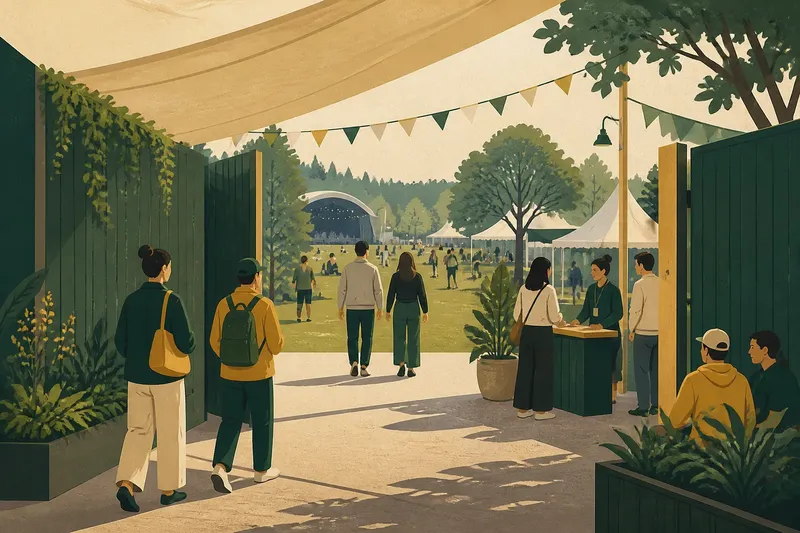
A compressed threshold narrows the view or route briefly, then opens into the festival. It might use a short passage beneath a fabric canopy, a line of temporary walls, or a turn between existing buildings. The change can make entry feel deliberate and give the interior a reveal.
This approach suits a compact site, a courtyard festival or an event where the view beyond the gate is visually busy. It can also help separate the practical business of entry from the atmosphere inside. A modest screen may conceal service equipment or backstage activity without pretending that the whole site is a secret garden.
The risk is that compression becomes a bottleneck. Keep ticket checks, bag searches and accessible routes from competing for the same narrow strip. A passage that makes people stop should have space beyond it for them to gather without standing in the flow. For fire routes, crowd capacity and accessible access, use a suitably qualified event professional and follow applicable local requirements.
Say a small arts festival enters through a broad arch beside a busy street. The organisers add a fabric canopy and angle a freestanding screen so the first view is of a calm courtyard, not the bins and delivery area. Visitors can still see the exit route and ticket point, while the new pause gives groups somewhere to regroup; the expected observable result is fewer people stopping directly in the arch.
Could an open sightline help people choose where to go?
An open sightline makes the next part of the site visible from the entrance. A stage roof, distinctive pavilion or tree-lined path can provide a visual destination, while the route between gate and destination remains easy to read. This is not the same as relying on a sign: the site itself does some of the explaining.
It suits festivals spread across a broad lawn, a park or a series of connected outdoor spaces, especially when visitors arrive in small groups and want to orient themselves quickly. It also works where the main event is visible but not immediately accessible; a clear route can show that the destination lies ahead without inviting people to cross a closed service lane.
Open views can expose the whole event at once, leaving little sense of arrival. They may also be less useful on sloping ground, among dense trees or where temporary structures interrupt the view. If a feature is meant to guide people, check that it can actually be seen from the approach at the height and angle visitors encounter it. A tall object hidden behind a food tent is an ambitious landmark for the food tent.
When should the first gathering point come before the main space?
A first gathering point is a small, obvious place to pause just inside the entrance: a forecourt, a broad patch of paving, a sheltered seating area or an open edge beside a welcome desk. It gives arrivals a place to meet, consult a programme or settle a child before they continue.
This approach suits festivals where people commonly arrive in groups, where the entrance meets a busy public path, or where the main performance area should not double as a reception hall. It is also useful when visitors need a moment to adjust from a noisy street or exposed field before deciding where to spend time.
The gathering point needs a clear onward route and a reason to stay out of the way. Put benches or a welcome table at the edge rather than in the middle, and avoid placing the only programme board where people queue to read it. If the area is too attractive but has no visible next route, it can become the festival’s unofficial waiting room.
Which entrance approach fits your site?
Choose by asking what visitors need most at the moment they cross the boundary: a pause, a destination they can see, or somewhere to regroup. Then check the approach against the site’s shape, arrival pattern and practical constraints. The options can be combined, but one should lead; otherwise the entrance may offer several competing invitations.
- Choose a compressed threshold when the site needs a distinct transition and there is room for a pause beyond the narrow section.
- Choose an open sightline when a visible feature can point towards the next area and the route remains clear.
- Choose a first gathering point when arrivals need space to meet or settle before moving into a denser programme area.
- Combine a threshold and gathering point when a reveal matters, but visitors also need somewhere to stop after it.
- Keep the entrance visually simple when the site has many routes or the main feature is already obvious; extra structures can obscure rather than clarify.
Draw the approach at visitor eye level, not only as a site plan. Mark the gate, the first place someone could stop, the first destination they can see and the route onward. If those points overlap, adjust the layout before adding decorative elements.
What do visitors need to see at the threshold?
The entrance should reveal enough to support the next decision, not every activity on site. A welcome desk, a clear route and one recognisable feature may be sufficient. Put immediate practical information where it can be read without blocking movement, and let later choices appear as visitors move further in.
Materials can help define the room without turning it into a permanent building. Timber frames, canvas, bunting, temporary flooring and planted containers each create a different edge; select them for the site and the weather they must face. Keep loose decoration out of circulation routes, and make sure the entrance still reads clearly when the area is busy or the light changes.
For a final check, stand at the approach and imagine arriving with a friend, a bag and no knowledge of the layout. Can you tell where entry happens, where you may pause and what lies beyond? If the answer depends on someone pointing from across the crowd, the entrance is asking for too much interpretation.
A festival entrance is most successful when its first room belongs to the people arriving, not to the design team’s preferred photograph. A clear threshold, a visible destination or a well-placed gathering point can each provide that welcome. For festival entrance design, choose the approach that makes the next action easiest to understand, then leave enough space for visitors to take it at their own pace.