The Volume Myth: Louder Does Not Always Mean More Atmosphere
A festival soundscape gains atmosphere through contrast, not sheer volume. Plan changes in density, texture and quiet so each space has a reason to listen.
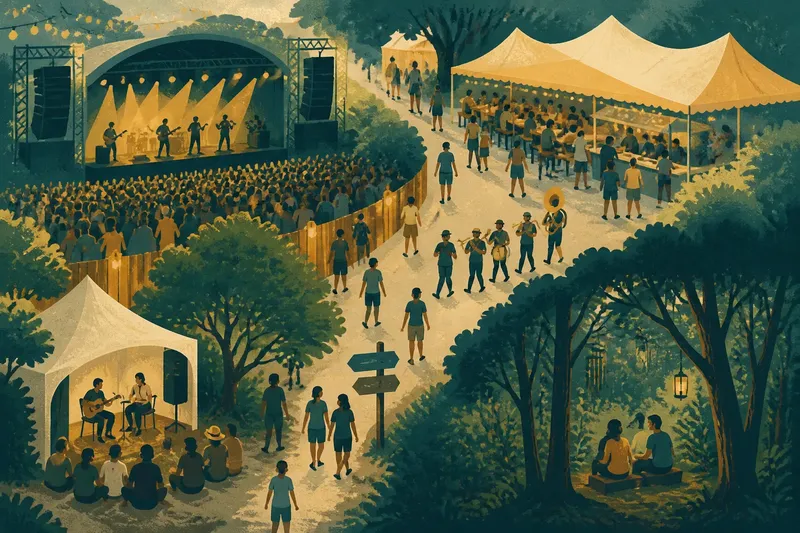
The common mistake in festival sound design is treating volume as a shortcut to atmosphere. Turn every stage, walkway and food area up, and the soundscape can lose its shape: music blurs together, quieter details disappear and visitors have little reason to move closer or pause. A more compelling festival soundscape gives the ear contrast to follow.
That contrast is not simply loud beside quiet. It can come from a change in rhythm, timbre, distance or density: a low drum line followed by a thin whistle, a busy stage opening onto a space with only wind in the trees, or a steady beat interrupted by a spoken voice. The aim is not to make every area equally noticeable. It is to give each one a distinct audible character.
Why can more volume flatten a festival soundscape?
When several sources compete at similar intensity, the listener has to work harder to pick out any one of them. A headline set may spill into a neighbouring performance; a quiet acoustic stage may become audible only when the crowd falls silent. The resulting impression is not necessarily energy. It may be one continuous wall of sound.
Sound also helps visitors understand a place without looking at it. A hand drum carried from a roaming group, a singer heard through an open tent flap, or the hush of a grove can suggest different ways to spend the next few minutes. If every sound is pushed forward, these distinctions become harder to notice.
Think of a festival soundscape as a table setting: if every dish is heavily seasoned, no single flavour has much room to register. A vivid sound does not need a constant increase in level; it needs something around it that lets its qualities come through.
What should a soundscape plan change over the week?
Start with the programme and the site map, not a master volume setting. Mark where sound travels, which activities overlap, and where people are likely to wait or gather. A stage facing an open field behaves differently from one tucked between canvas walls; the surrounding surfaces and distance affect how much sound reaches other areas.
Then sketch the week as a sequence of listening conditions. The plan can be revised as the programme takes shape, but it should give each day and area a recognisable pattern rather than asking every performer to provide the same level of intensity.
- Early programme planning: Note the sound character of each event, such as acoustic strings, spoken word, hand percussion or amplified dance music. Look for adjacent events that differ in texture, not just genre.
- Site review: Walk the likely audience routes and identify places where sound from two activities may overlap. Record whether a path, tent wall or open space separates them; these are clues for later planning, not a substitute for a proper sound check.
- Schedule shaping: Avoid arranging every area to peak at once. Where possible, let one performance become more spacious while another becomes denser, so the whole site has movement without a single unbroken crest.
- Production discussions: Share the intended character of each area with performers and sound teams. Ask what should be easy to hear from the audience area, and what can remain a detail for people who choose to come closer.
- Pre-opening review: Listen from the places visitors will actually occupy, including paths and seating edges. Note whether voices, musical details and transitions remain distinct, and adjust the plan with the relevant sound professionals.
Say a small outdoor stage is scheduled beside a food court, with a brass group playing during a busy afternoon. The organiser shifts the brass performance to a slot when the nearby programme is less rhythmically dense and gives the food-court area a quieter musical texture. The expected result is that the brass line is easier to recognise from its own audience space, while the adjoining area still feels inhabited rather than silent.
How can contrast be designed without making quiet feel empty?
Quiet is not the absence of design. A low-volume performance can hold attention through clear words, delicate instruments, or a close relationship between performer and audience. A shaded listening area might use soft, intermittent sounds rather than continuous background music; people can then hear the space itself as well as the programme.
Variety can also come from the sound source. A distant chorus, a small bell, a sustained drone or the irregular pattern of footsteps all have different shapes. Used with care, these sounds make a place feel inhabited without filling every gap. The distinction matters: a pause is not automatically dead air, and a background track is not automatically atmosphere.
Give transitions their own consideration. A set ending in a sharp cut can make the next event feel abrupt; a gradual change may suit a relaxed area, while a deliberate pause can help mark a new performance. There is no single right transition. The useful question is what the audience should notice as one event gives way to another.
What should you listen for during the festival?
During the event, take a short listening walk at different points in the schedule. Stand in the audience area, then move to a nearby path or seating edge. Listen for whether the intended performance remains recognisable and whether sound from elsewhere is adding useful context or simply masking it.
Keep notes in plain language: “voice lost near the tent opening”, “percussion carries into the reading area”, or “the grove has a clear pause after the music”. These observations give the production team something specific to consider. They are more useful than a general request to make a place louder or quieter.
Where a change is needed, involve the people responsible for sound and the relevant performers. They can consider the appropriate adjustments for the equipment, event and site. The festival organiser’s role is to describe the listening problem and the desired experience, rather than improvise technical changes from the audience boundary.
Which sound decisions matter most to visitors?
Visitors rarely experience a site as a set of isolated stages. They hear a route: a distant bass line while crossing an open area, a conversation under a canopy, then a sudden close-up of strings from a small performance. That sequence can make the festival feel varied even when no single moment is exceptionally loud.
It is also worth considering who needs to hear what. A spoken announcement, an intimate performance and a dance set ask for different kinds of attention. Clear placement and suitable sound design can help those activities be understood without turning the whole site into an announcement system. For access needs or particular events, discuss sound requirements with the relevant specialists and performers.
How can you tell whether the balance is working?
Use these questions during planning and review:
- Can a visitor tell which nearby activity is producing the sound?
- Does each area have a recognisable texture or rhythm?
- Are there moments when a change in sound gives the audience room to reset?
- Does sound from one area obscure speech or music in another?
- Can a visitor move between lively and quieter experiences without leaving the festival atmosphere behind?
These are listening prompts, not technical standards. Specific sound limits and equipment requirements depend on the site, event conditions and applicable rules, so confirm them with the responsible professionals and local authorities where needed.
The volume myth is easy to understand: loudness is immediately noticeable, while contrast takes a little more thought. Yet a festival soundscape often feels richer when one sound has room to recede and another has room to emerge. Plan for that movement across the week, and the result can invite attention rather than demand it.
When the next programme draft is ready, read it once without looking at stage names. Imagine the sound each time slot contributes to the wider site. If every moment seems to press forward, revise the sequence before reaching for the volume control.